Quick Answer
Knee osteoarthritis is a long-term condition in which the tissues of the knee gradually change, causing pain, stiffness and reduced movement. Doctors often describe severity as grades 0 to 4 on an X-ray using the Kellgren-Lawrence scale, but the grade does not match symptoms exactly. Treatment usually starts with exercise, weight management where relevant and pain relief. Surgery is considered mainly when symptoms limit daily life despite those measures. The right plan depends on your symptoms, function and examination.
In Brief
- The stage of knee osteoarthritis usually means an X-ray grade from 0 to 4.
- Symptoms and X-ray findings do not always line up, so treatment is guided by how the knee functions.
- Exercise and weight management are core treatments in major guidelines.
- Some popular options, such as glucosamine and arthroscopic washout, have little or no guideline support.
- Knee-preserving surgery and knee replacement are options for selected people, not a rule for any one grade.
If you have been told you have grade 2 or stage 3 knee arthritis, the label can sound like a countdown to surgery. It is not. This article explains what the grades measure, what symptoms to expect, how the main treatments compare, and what usually leads to a surgical conversation.
What Is Knee Osteoarthritis?
The ends of the thigh bone and shin bone are covered by smooth articular cartilage, with two C-shaped menisci acting as cushions. In osteoarthritis, the cartilage becomes frayed and thinner, the bone beneath it changes, bony spurs (osteophytes) can form, and the joint lining can become inflamed. It is often called “wear and tear” arthritis, but it involves the whole joint, not just the cartilage.
There is no cure, but the NHS notes that the condition does not necessarily get worse over time. Many people manage it with non-surgical care for years.
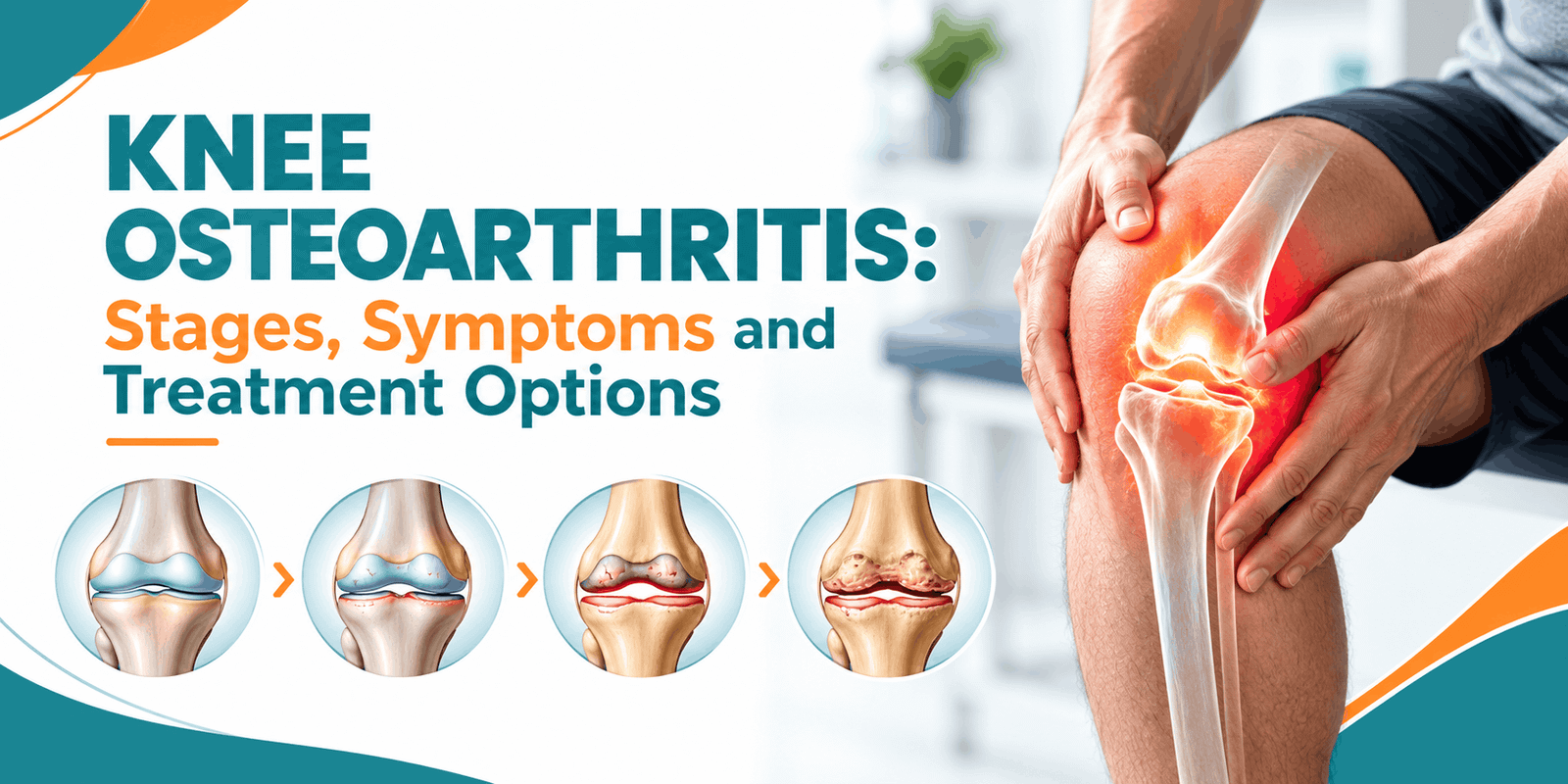
The Stages of Knee Osteoarthritis (Kellgren-Lawrence Grades)
The most widely used staging system grades knee X-rays from 0 to 4. The descriptions below follow the Indian Council of Medical Research’s standard treatment workflow.
| Grade | What the X-ray Shows | What It Generally Means |
|---|
| 0 | No signs of osteoarthritis | Knee pain at this point usually has another cause |
| 1 | Doubtful narrowing of the joint space, possible small bone spurs | Changes are uncertain; many people have few symptoms |
| 2 | Definite bone spurs, possible narrowing | Early definite osteoarthritis; care focuses on exercise, weight and symptom control |
| 3 | Multiple bone spurs, definite narrowing, hardening of bone, possible deformity | Moderate osteoarthritis; non-surgical care continues, and function is reviewed closely |
| 4 | Large bone spurs, marked narrowing, severe hardening, definite deformity | Severe on X-ray; surgery may be discussed if function is badly affected |
Two cautions apply. First, some websites describe four stages and others five levels (0 to 4); they are describing the same family of scales. Second, the grade is a snapshot of the X-ray, not a measure of how your knee feels. NHS trust leaflets note that many people with X-ray changes have mild or no symptoms, and NICE advises that management be guided by symptoms and physical function. A person with grade 2 changes may have more pain than someone with grade 4, and the reverse can also be true.
Symptoms and Risk Factors
Common symptoms include:
- Pain that builds with activity and eases with rest
- Stiffness after sitting or in the morning, usually short-lived
- Reduced bending or straightening, making stairs, chairs or car seats harder
- Creaking or crackling on movement
- Swelling or warmth in the joint
- In later disease, a visible change in leg shape, often a bow-legged appearance
Risk factors include age, family history, body weight, a previous knee injury, jobs involving repeated kneeling, squatting or heavy lifting, and earlier knee problems such as gout or infection.
When to See a Doctor
See a doctor if knee pain or stiffness persists or interferes with daily activity. Seek prompt medical attention, without waiting for a routine appointment, if you have a hot, red, swollen knee (particularly if you also feel unwell or feverish), knee pain after an injury or inability to put weight on the leg, sudden marked swelling, or rapid worsening or change in the shape of the knee. NICE lists these as features that suggest a cause other than typical osteoarthritis.
You can also read about the causes of knee pain for information about other possible reasons for knee discomfort.
How Knee Osteoarthritis Is Diagnosed
In typical cases, a doctor can diagnose it from your history and examination. NICE says imaging is not routinely needed for people aged 45 or over with activity-related knee pain and morning stiffness lasting 30 minutes or less. X-rays or blood tests may be used to rule out other problems such as rheumatoid arthritis or a fracture. Indian guidance lists standing front and side knee X-rays, which also give the grade and show alignment, and orthopaedic surgeons commonly rely on them when surgery is under discussion.
Treatment Options
Exercise and Weight Management
NICE names therapeutic exercise and, where relevant, weight management as the core treatments. Exercise is tailored to the person (for example, muscle strengthening and general fitness) and may be supervised. Pain can increase at first, and regular, consistent exercise is expected to help over time. For people living with overweight, NICE says any weight loss is likely to help, and that losing 10% of body weight is likely to be better than 5%. A walking stick can help when walking is limited. The ICMR workflow also suggests avoiding cross-legged sitting and deep squatting where possible.
Medicines
A topical anti-inflammatory gel is the usual first step in NICE guidance. Oral anti-inflammatory tablets may be considered if topical treatment is not enough, using the lowest effective dose for the shortest time. They carry stomach, kidney, liver and heart risks that your doctor will weigh. Guidelines differ on paracetamol: NICE does not routinely offer it, while the Indian workflow lists it. Strong opioids are not advised, because NICE judges their risks to outweigh the benefits. Dosing is a decision for your doctor.
Injections
A corticosteroid injection into the knee may help a flare or support exercise, but NICE describes the relief as short-term (2 to 10 weeks). The 2026 American College of Rheumatology update, as reported by Healio, strongly recommends against platelet-rich plasma and stem-cell injections for knee osteoarthritis. Evidence for hyaluronic acid has been debated and guideline positions have varied, so ask your doctor what the current evidence supports.
Supplements
NICE found no strong evidence of benefit for glucosamine, and the ACR 2026 update strongly recommends against glucosamine and chondroitin.
Braces, Insoles and Walking Aids
NICE does not routinely offer braces and insoles, except where there is joint instability or abnormal loading and exercise alone is not enough. Other guidelines are more favourable in selected people, so this is worth discussing. A walking stick may help if walking is limited.
Arthroscopy
NICE says not to offer arthroscopic washout or debridement for osteoarthritis, and OrthoInfo notes that the more advanced the arthritis, the less effective arthroscopy is. A separate mechanical problem, such as a meniscal tear, needs its own assessment. Read more about knee arthroscopy only after discussing whether it is relevant to your specific knee problem.
Surgery
Two main operations are used when non-surgical care is no longer enough. High tibial osteotomy cuts and realigns the shin bone to shift load away from the worn side; the ICMR workflow says it may be considered in younger patients with significant bow-leg deformity. Learn more about knee-preservation surgery (HTO) and high tibial osteotomy.
Knee replacement, partial or total, removes damaged surfaces and replaces them with implants. For total knee replacement, the ICMR workflow describes grade 4 osteoarthritis with features such as severe pain or stiffness limiting daily activities, inability to walk short distances, long-term regular pain-relief use, moderate or severe pain at rest, or severe deformity, after appropriate conservative treatment has failed. Active knee infection is a contraindication. NICE advises against excluding people from referral for replacement because of age, sex, smoking, other conditions or BMI, while explaining that risks vary with those factors. As with any surgery, there are risks and the NHS notes that results cannot be guaranteed. You can read about total knee replacement and partial knee replacement.
| Treatment Option | Who It Is Generally Considered For | Main Limits |
|---|
| Exercise and weight management | Almost everyone with knee osteoarthritis | Needs consistency; pain may flare at first |
| Topical or oral medicines | Pain that limits exercise or daily activity | Short-term symptom relief; oral drugs carry side effects |
| Corticosteroid injection | Flares, or to enable exercise | Relief is short-lived (about 2 to 10 weeks per NICE) |
| High tibial osteotomy | Often younger, active people with damage mainly on one side and bow-leg alignment | Longer protected recovery; may only delay later replacement; not suited to whole-knee disease |
| Partial knee replacement | Damage confined to part of the knee, judged by the surgeon | Depends on how many compartments are affected |
| Total knee replacement | Severe symptoms and function loss despite other treatment | Major surgery with risks; implant lifespan matters most for younger patients |
What Recovery Involves
Recovery depends on the procedure, the person and the rehabilitation plan, so a single timeline would mislead. After osteotomy, the bone must heal while the knee is protected; after replacement, physiotherapy rebuilds movement and strength. Ask your surgeon for the expected sequence for your own operation instead of relying on a generic number. You can also read about what a knee replacement procedure involves.
Questions to Ask at a Consultation
- What is my X-ray grade, and what does it mean for my symptoms?
- Which non-surgical measures have I not yet tried properly?
- Which part of the knee is affected, and does alignment matter in my case?
- Am I a candidate for osteotomy, partial or total replacement, and why or why not?
- What are the risks specific to my age, weight and health conditions?
- What will rehabilitation involve, and for how long?
- What happens if I decide to wait?
How Dr. Viraj R. Patel at Aarunya Hospital May Help
Dr. Viraj R. Patel is an orthopaedic surgeon in Gandhinagar whose practice website lists total knee replacement, knee-preservation surgery (HTO) and arthritis care among its services. A consultation typically starts with your history, an examination and a review of X-rays, so that non-surgical and surgical options can be discussed against your own symptoms and goals. Whether any procedure is appropriate is a clinical decision made for each person. Learn more about the hospital’s arthritis care or visit the contact page for appointment-related information.
Expert Summary
The grade on your X-ray describes structure, not suffering. Most decisions turn on how much the knee limits your life, how far exercise, weight management and medicines have helped, how the knee is aligned, and your general health. Surgery is a considered step for selected people, not an automatic next stage.
Key Takeaways
- Grades 0 to 4 describe X-ray findings and do not predict symptoms precisely.
- Exercise and weight management are core treatments in NICE and ACR guidance.
- Glucosamine, PRP, stem-cell injections and arthroscopic washout have weak or negative guideline support.
- Corticosteroid injections give short-term relief only.
- Replacement referral rests on clinical assessment of pain and function, not the grade alone.
- A hot, swollen knee or pain after injury needs prompt medical attention.